How markets reacted to a March tumble
Quarterly performance update: How we preserve capital during global uncertainty
April 22, 2026
The first few weeks of 2026 looked a lot like the relatively calm markets that closed out 2025. Expected and actual volatility held at record lows, while market returns continued marching upwards. Unfortunately, the war in Iran and, more specifically, the closing of the Strait of Hormuz, a significant corridor for the global oil trade, added a lot of unexpected volatility.
The TSX 60, S&P 500, and MSCI EAFE — which tracks developed markets outside of Canada and the U.S. — all posted gains in January and February, but retreated 3.1%, 5%, and 8.3%, respectively, in March. Brent crude, the global benchmark for oil prices, jumped 43% between the start of the war and the end of Q1 (and has since fallen a bit).
Because of how integral oil is to the economy, investors took this price shock to mean a slowdown in growth. In turn, central banks are expected to raise interest rates to tamper down any corresponding inflation, and those expectations hurt government bonds. Even gold, the shining star of the last few years, tumbled roughly 10% in March as investors increasingly shifted to the stability and liquidity of cash reserves.
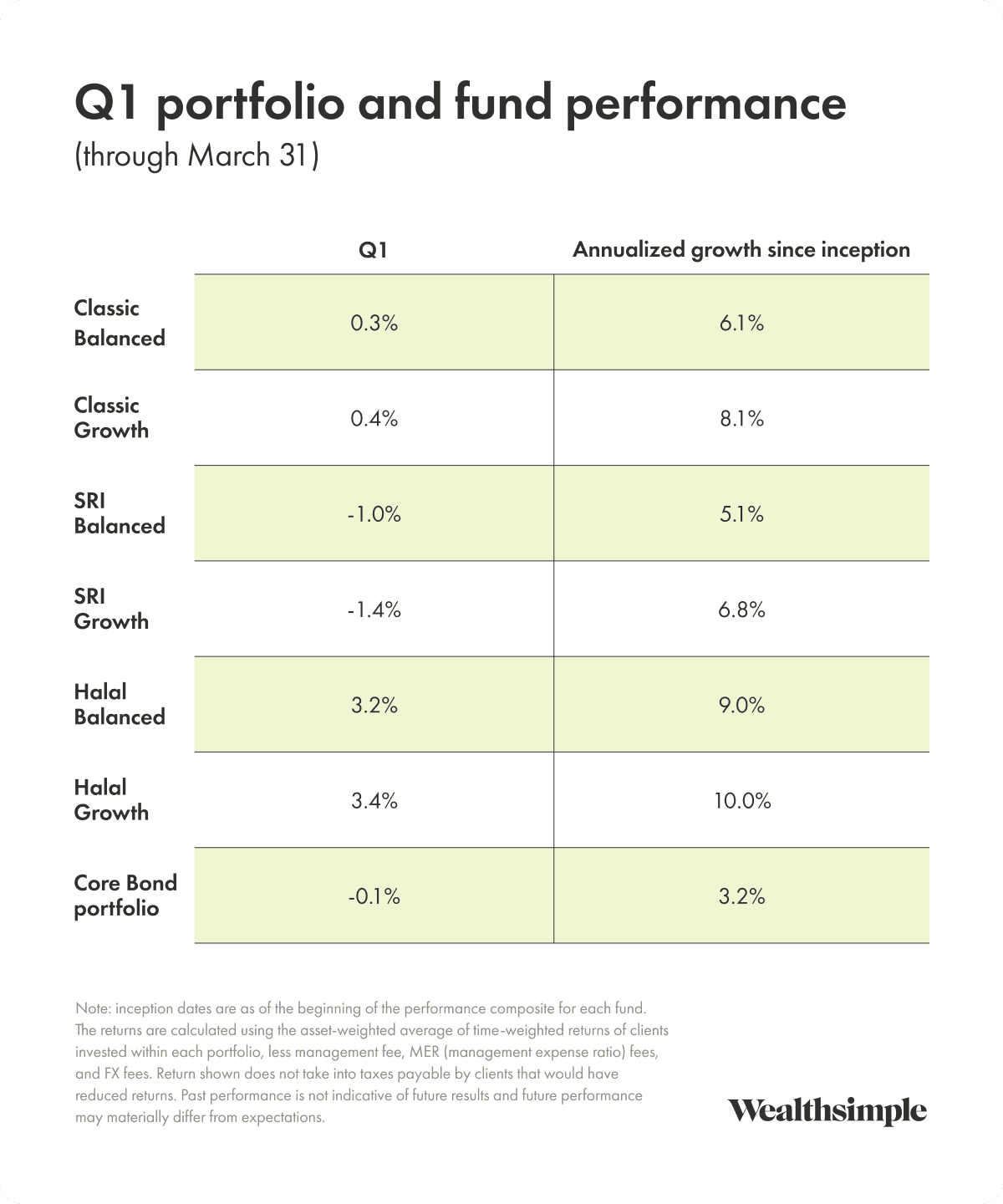
Here’s how our different managed portfolios performed in the last quarter. If you’re invested in alternative assets with us, you can expect that performance update next month when the data is available.
Managed portfolios
Our goal isn’t to predict how the market will react next. It’s to build diversified portfolios that will weather any storm — to grow in good times and preserve capital during periods of volatility, like we experienced this past quarter.
While lower than expected, our first-quarter returns are in line with broader market trends for every asset class. Canadian stocks and gold led the way in terms of positive return drivers. Because we rebalance our portfolios automatically, we were able to keep portfolios close to their target weights as these markets rallied through February, so they didn’t suffer as badly during the subsequent downturn in March. U.S. stocks, however, lost value, while fixed income and global stocks both ended Q1 roughly flat.
Our Halal Managed portfolio modestly outperformed Classic thanks to its large gold allocation, while our Socially Responsible Investing portfolio fell short because, by design, it doesn’t invest in oil and gas stocks. The deviations of both portfolios are nonetheless within their expected performance ranges for any quarter.
Core Bond portfolio
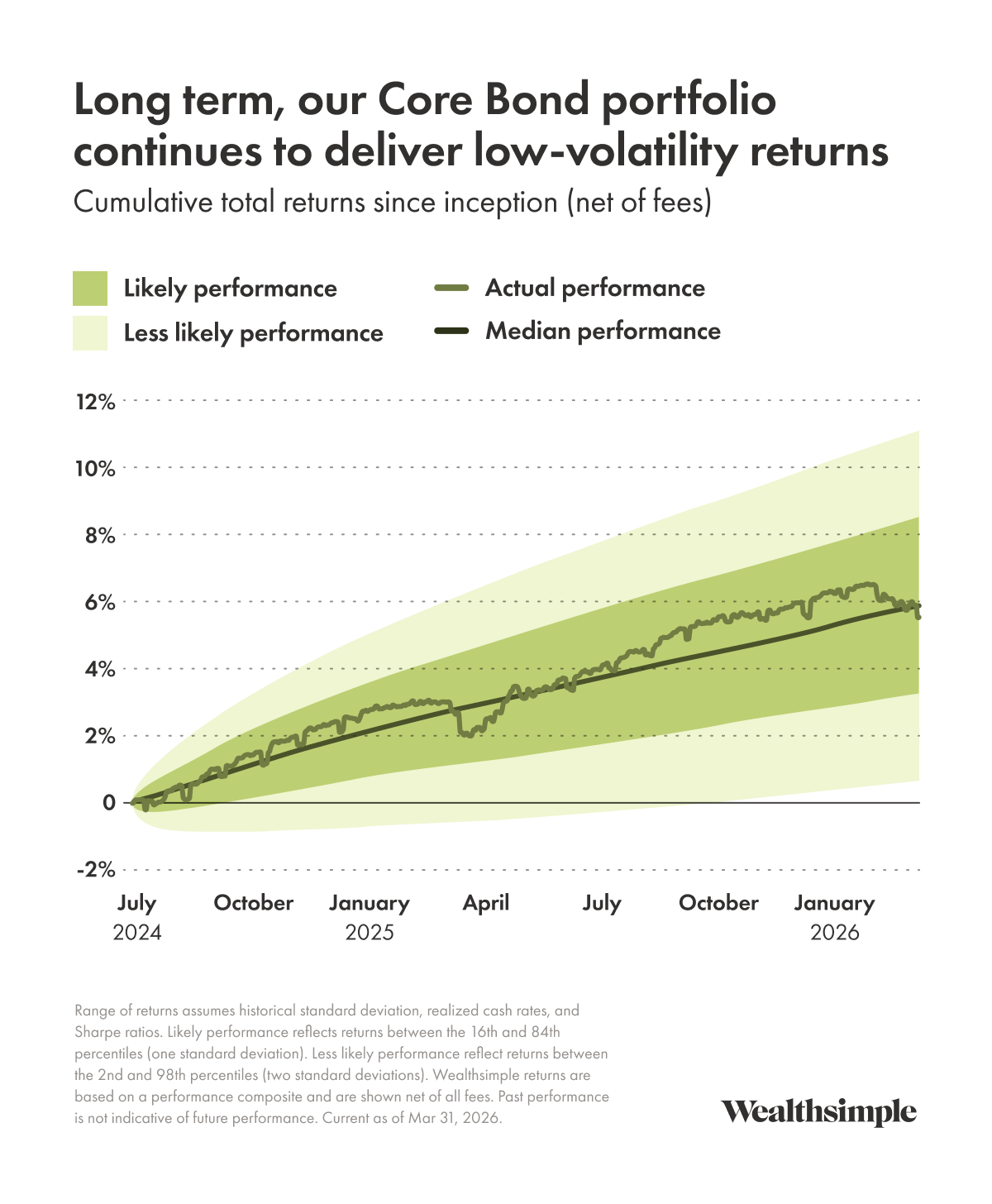
In Q1, our Core Bond portfolio fell 0.1%, which is consistent with a period of rising inflation and bond yields. This is below our quarterly growth expectations of 0.7% to 1%, but total returns since inception are at 5.5%. The portfolio’s yield to maturity, or the expected returns you’d get by holding this particular mix of securities over any time period, is currently 3.5% — roughly 1.0% above the rates for our Money Market portfolio, and right on target.
Our outlook
A near-term rebound in asset markets depends heavily on what happens next in Iran. We've seen oil prices slide since Q1 as key leaders from the U.S., Israel, and Iran, along with mediators from Pakistan, try to negotiate a resolution to the war. However, oil and gas analysts broadly believe the shock from rising global energy prices will become much harder to manage if oil tankers are unable to freely transit the Strait of Hormuz. Many nations have been able to tap into strategic petroleum reserves to satisfy their domestic demand, but these stores are not infinite, and alternative fuel sources can’t replace the missing oil imports fast enough.
The primary focus for many investors is whether continued supply constraints will lead to further oil price increases and rationing, causing a further deterioration in growth across the global economy, or whether a lasting resolution of the war could quickly slake ongoing energy demands. The latter, should it happen, won’t completely negate the current oil price shock — it would take some time to load all of the Gulf’s backlogged oil onto tankers and move it through the Strait — but could meaningfully decrease the market volatility we saw in Q1.
We’re paying close attention to market news and how it lines up with our performance expectations for our Managed portfolios. As worrisome as current events may feel, often the best strategy for any investor in tumultuous conditions is patience and diversification. None of us can control what happens in the world, but by investing in a broad basket of assets, we can take steps to ensure we’re on a solid financial footing no matter what happens.
Legal
Have questions? Contact us.
Past performance does not guarantee future results. Private equity involves risks including, but not limited to, risks related to economic and market conditions, interest rates, the availability and performance of investment opportunities, regulatory and tax law changes, and business and company news and developments. See here for more information.
Managed accounts are offered by Wealthsimple Inc., a registered portfolio manager in each province and territory of Canada. Assets in your Invest account are held in an account with Wealthsimple’s affiliated custodial broker, Wealthsimple Investments Inc. (WSII). WSII is a member of the Canadian Investment Regulatory Organization (CIRO). Customer accounts held at WSII are protected by Canadian Investor Protection Fund (CIPF) within specified limits in the event WSII becomes insolvent. A brochure describing the nature and limits of coverage is available upon request or at CIPF. Wealthsimple Inc. is not a member of CIRO nor a member of CIPF.
Managed accounts are offered by Wealthsimple Inc., a registered portfolio manager in each province and territory of Canada.
© 2026 Wealthsimple Technologies Inc.