Answers to your biggest RRSP questions
How to make the most out of your RRSP
February 3, 2026
Welcome to RRSP season. (It’s almost as exciting as tax season!) This time of year, our team receives even more questions than usual from clients trying to make the most of their retirement savings. In case you are going through something similar, we’re addressing one big (and too-frequent) RRSP misunderstanding that can cost you thousands — both in tax savings and eventual retirement income — and answering some of the most common questions we get. And in case you were wondering how much your RRSP savings today can pay off in the future, we also made a chart! Let’s get to it.
A lesson in RRSP balancing: don’t forget to account for household income!
If your household is just you, RRSP calculations are pretty simple. Assuming you’re earning more now than you will be when you withdraw your money (most likely in retirement), the best choice is often to contribute as much to your RRSP as you can afford. But if you have a partner who also works, the decision gets more complicated. That’s because RRSP contributions are about balancing not only the refund you get today, but the tax rate you’ll pay tomorrow.
When two spouses have very different incomes and significantly different tax rates, the higher-earning spouse should make most, if not all, of the household’s total RRSP contribution. That can be through direct contributions to their own RRSP or through a spousal RRSP, which has the added bonus of leveling out income and taxes in retirement. This way, you take advantage of the higher earner’s higher tax rate and get a higher refund. But that’s not always what we see people do.
Let’s look at a couple, both 45, who live in Ontario and are saving for retirement. One partner earns $220K per year and pays a marginal tax rate of 48%, while the other earns $60K and pays 30% in taxes. Each has $100K saved and no pension.
They have $20K to invest in their RRSPs this year. They also have a choice:
- Split that amount in half, so each partner makes an equal contribution
- Put all of the money in the RRSP of the higher earner
- Have the higher earner contribute to the lower-earner’s spousal RRSP
Scenario 1 - Splitting the contributions evenly
This keeps the couple’s total savings similar, helping to flatten out their taxes in retirement. But it doesn’t get them the maximum current refund. The higher earner gets $4,800 back from their $10K contribution, while the lower earner gets back $3,000, for a total of $7,800.
Scenario 2 - Maximizing the higher-earner’s contribution
If the higher-earning spouse contributes the entire $20K into their RRSP, the couple gets the maximum household refund for the year: $9,600. The problem is that, if repeated, this choice could set them up for a huge savings imbalance in retirement. If one person has a much larger RRSP, they’ll be in a higher tax bracket in retirement, subjecting the household to more taxes than they need to pay.
Scenario 3 - Using a spousal RRSP
This is the best option. The higher earner contributes $10K to their own account and $10K to their partner’s spousal RRSP. That helps keep the balance in each account equal, while still earning the maximum household refund of $9,600. The lower-earning partner becomes the long-term owner of the assets, flattening out their tax obligations in retirement and potentially saving the couple money down the road.
There are many other factors that can impact your specific RRSP contribution strategy, of course — including pensions, existing RRSP account balances, and changes in future earnings. But just like in marriage, if you go in thinking only of yourself, you’re probably not going to have the best outcome.
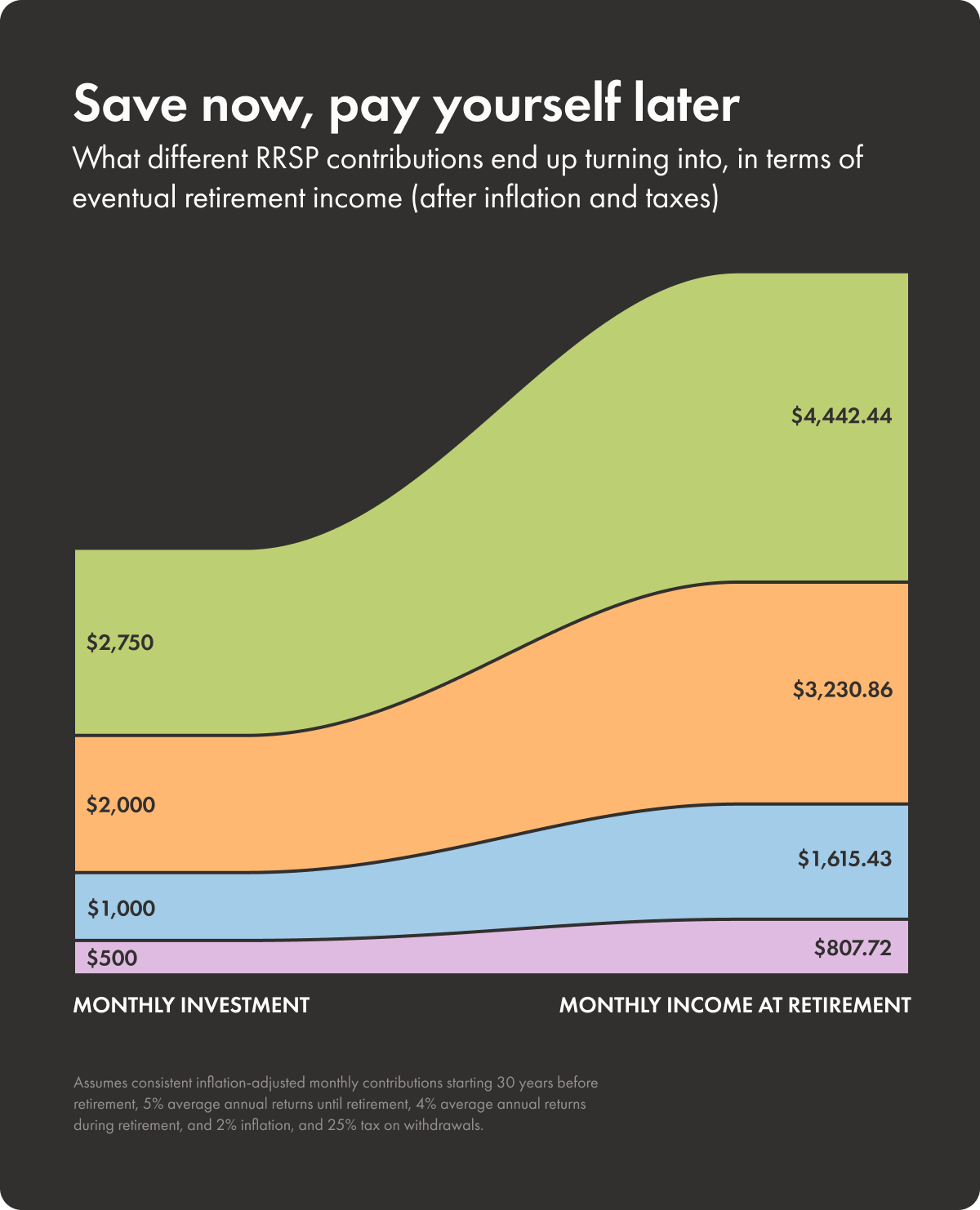
An RRSP chart: what today’s savings mean for tomorrow’s income
Sometimes saving can feel like blind trust. You’re depriving yourself right now for the hopes of having more in the future. But how much more can you reasonably expect?
And finally, an RRSP lightning round!
- How can I see how much contribution room I have? Just log into your CRA account and check your most recent Notice of Assessment. There’s a heading called “Available Contribution Limit.” But remember: the number you see there doesn’t include any contributions you made after last year’s deadline. (Learn more about RRSP contribution limits here.)
- Do pension deductions impact RRSP room? Yes, the pension benefit you earn each year counts against your contribution room. That can be easy to forget, which can lead to overcontribution penalties. Pension holders also need to factor that income into their expected marginal tax rate in retirement. If your expected pension is significant, your retirement income and tax rate could be similar to your working years, which could mean you should be prioritizing your TFSA first. (Learn more about registered pension plans here.)
- I think I’ll be making more money in the future. Should I delay making RRSP contributions so that I can get a bigger refund later? This strategy can make a lot of sense, particularly if you have TFSA room available to use instead, and have a confident expectation of a sizable bump in income that will put you well into a higher tax bracket within the foreseeable future.
- Is there a penalty for taking money from an RRSP before retirement? No, but you will pay some tax. Your total tax payable will be determined by the amount you withdraw and your marginal tax rate at the time. You can determine your marginal tax rate by consulting tax tables like this one. (Learn more about RRSP withdrawals here.)
Even if none of these scenarios feel applicable to you, RRSPs really are the most potent retirement wealth builder for many Canadians. Although, as with any investment vehicle, there’s one hitch: you have to actually use it. The deadline to make contributions to your RRSP that reduce your 2025 taxes is March 2. If you miss it, the contribution room does carry over, but you’ll never get another chance at that time in the market.
Legal
Promo Terms: From January 13 - March 31, 2026, new or existing Wealthsimple account user who registers for the promotion then initiates an institutional transfer of an existing account from a qualifying third party to a Wealthsimple Self-directed Investing, Managed Investing, Crypto, or Chequing account will receive a 1%, 2% or 3% Match Bonus of the cumulative transferred amount (less withdrawal) during the promotion period. Transfers must be received on or before June 29, 2026. Maximum 1 Bonus per client. Minimum fund holding period required. Must be residents of Canada and age of majority. See full T&Cs at wsim.co/unrealdealContest Terms: No purchase necessary. Contest begins on Jan 13, 2026 at 12:01am Eastern Time (ET) and ends on Mar 31, 2026 at 11:59pm ET (“Contest Period”). 1 prize available to be won in Canada, consisting of a furnished property in Lions Bay, British Columbia, costs related to transferring the property into the winner’s name and a lump sum of $100,000 CAD to cover costs of ownership of the property throughout the contest winner’s period of ownership (ARV CAD$3,400,000). To enter for 5,000 entries into the contest, during the Contest Period, be a new or existing Wealthsimple client with an active account balance of least CAD$1 and register for the 2026 Wealthsimple Winter Match Promotion - The (Un)Real Deal. Additional entries may be obtained via: (i) deposit or transfer funds to a Wealthsimple account within 30 days of registering; every CAD$1 of funding less withdrawal or transfer out balance equals one (1) additional entry, (ii) refer a friend to open a new Wealthsimple account and fund at least CAD$1 into the account within 30 days of registering; each successful referral equals 20,000 entries. Entrants who successfully qualify for the Match Promotion receive 2x entries from registration, deposits/transfers, and referrals. No purchase entry: enter via the essay method; first essay equals 5,000 entries, subsequent essays equal 1 additional entry and qualifying referrals equal 20,000 entries. Limit of 10,000,000 entries per Entrant: 5,000 entries from Registration and 9,995,000 via the other methods. Odds of winning depend on the total number of eligible entries received during the Contest Period. Skill-testing question required. Open only to new or existing Wealthsimple clients, who are citizens/or permanent residents of Canada and legal residents of Canada and are the age of majority in the province or territory of residence at the time of entry. Full rules and entry details available here wsim.co/unrealdeal
Managed accounts are offered by Wealthsimple Inc., a registered portfolio manager in each province and territory of Canada.
© 2026 Wealthsimple Technologies Inc.